
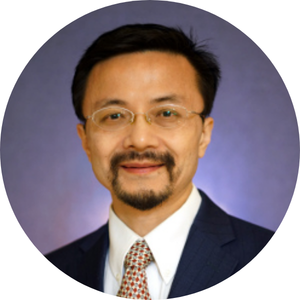
 Prof. Dr. Yan Wang Short bio: Yan Wang, Ph.D. is a Professor of Mechanical Engineering and leads the Multiscale Systems Engineering research group at the Georgia Institute of Technology. His interest of quantum scientific computing started over a decade ago. The research of the group also includes materials design, uncertainty quantification, and physics-informed machine learning. Their work received several best paper awards at the IEEE International Conference on Quantum Computing & Engineering, American Society of Mechanical Engineers (ASME) Computers & Information in Engineering Conference, ASME Multibody Systems, Nonlinear Dynamics & Control Conference, The Minerals, Metals & Materials Society (TMS) World Congress on Integrated Computational Materials Engineering, the Institute of Industrial & Systems Engineers (IISE) Industrial Engineering Research Conference, and the International CAD Conference. Prof. Wang is a recipient of the U.S. National Science Foundation CAREER Award, a National Aeronautics and Space Administration (NASA) Faculty Fellow, and an ASME Fellow. He currently serves as the Editor-in-Chief of the ASME Journal of Computing and Information Science in Engineering. | Title of the talk: Simulation-Based Design Optimization in Quantum Scientific Computing Short abstract: Quantum scientific computing is a new discipline to study and develop quantum algorithms and methods to solve engineering and science problems, such as simulation and optimization, on quantum computers. In the past decade, we investigated new hybrid quantum-classical approaches to perform simulation-based design optimization. Quantum walk was embedded in the Grover adaptive search algorithm which showed the improved convergence. A continuous-time quantum walk strategy was also developed to accelerate classical stochastic dynamics simulations. More recently, we developed a Bayesian version of quantum approximate optimization algorithm to quantify the uncertainty in variational quantum circuits. Two mixers were proposed to achieve the better exploration-exploitation balance. A variational quantum algorithm was developed for topology optimization where entanglement is utilized for the simultaneous search for optimal configurations and solutions of constraints. In addition, a generic quantum functional expansion and a scalable variational quantum simulation method were proposed to solve differential equations. We demonstrated the approaches in solving linear, nonlinear, and stochastic differential equations. |