Recent advancement in quantum/quantum-inspired black-box optimization

This abstract has open access
Problem description and relevance

We address the challenge of high-dimensional black-box optimization (BBO), where the objective function is unknown, non-differentiable, and expensive to evaluate. This problem arises in various real-world engineering tasks such as turbomachinery design using computational fluid dynamics (CFD) and automotive structural optimization, where hundreds of design variables must be tuned under physical and operational constraints.

While conventional BBO techniques-including Bayesian optimization, evolutionary strategies, and surrogate-assisted approaches-perform well in low-dimensional spaces, their effectiveness diminishes significantly as the number of decision variables increases. This limitation, often called the "curse of dimensionality," poses a significant challenge for high-dimensional BBO tasks in industry. Also, these methods do not natively handle constraints among the decision variables.

A BBO method based on quantum/quantum-inspired optimization solvers (QA-BBO) can address these issues associated with the conventional BBO methods. QA-BBO includes methods such as Factorization Machine with Quadratic-optimization Annealing (FMQA) [1, 2] and polynomial-based Kernels with Quadratic-optimization Annealing (Kernel-QA) [3]. QA-BBO utilizes surrogate models such as FM and kernel models within a serial optimization framework (like Bayesian optimization). While these surrogate models are typically low-dimensional, they require relatively a small number of model parameters, thereby mitigating overfitting even with small training datasets. 

In this work, we focus on two practical enhancements for QA-BBO-exponential transformation of objective values and training-data subsampling-and examine their impact on both benchmark and industrial problems.

Submission ID :
16
Methodology :

We investigate the following two strategies for improving the robustness and sample efficiency of QA-BBO.

Exponential data transformations

In minimization problems, the black-box function values are expected to gradually approach the true optimum. Consequently, the overall dynamic range of the training data tends to become relatively large, which in general has adverse effects on the surrogate model's predictive performance. One effective approach to improving the predictive performance of the surrogate model is to transform (scaling) the objective values in the training data.

Here, we apply an exponential transformation:
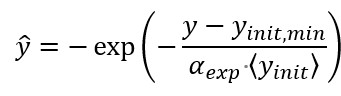
Here,is the original objective values and  is the transformed values (the ones to be used for surrogate model training). The subscript, init, denotes initial training data. is the averaging operation. is the hyperparameter which is typically unity.

Training data subsampling

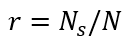
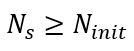
The data subsampling has been proposed in [4]. Basically, from the entire training data ofsamples, the surrogate model is trained by using onlysamples randomly chosen. Here, the ratiois pre-determined and a hyperparameter. In the present study, we impose an additional constraint that.
Practical demonstration :

We introduce benchmark and practical examples of QA-BBO methods, executed using a publicly available Ising machine with and without aforementioned methods.

Key examples to be presented at the conference will include:

  • Turbomachinery design optimization involving high-fidelity CFD simulations to minimize the hydrodynamic loss of the device.
  • Three-vehicle model structural design optimization to minimize total weight and to maximize the number of parts used commonly across multiple vehicles while satisfying safety, structural, and manufacturing-related constraints. The number of real decision variables exceeds 200.
  • Optimization of mixed-precision quantization for machine learning models to reduce computational latency while improving accuracy.
  • Topology optimization of a heat transfer device.
  • Benchmark tests evaluating performance compared to baseline methods.

These examples showcase the practical value of such approaches for tackling complex, expensive optimization tasks in engineering design and beyond. Although these demonstrations currently use a quantum-inspired solver, QA-BBO can be executed on real quantum annealers or gate-model quantum computers via algorithms like the Quantum Approximate Optimization Algorithm (QAOA), when these technologies matured.

Application potential :

The proposed QA-BBO methods are designed with scalability and quantum-readiness in mind. Their QUBO-based formulation makes them compatible with quantum annealers and potentially adaptable to gate-based quantum workflows such as QAOA. This flexibility positions QA-BBO as promising candidates for next-generation hybrid quantum-classical optimization workflows.

In practical settings, many engineering optimization problems are characterized by high-dimensional design spaces, expensive function evaluations, and complex constraints. QA-BBO addresses these challenges by combining data-efficient surrogate modeling with powerful combinatorial optimization solvers, enabling effective exploration of large search spaces under limited evaluation budgets. In particular, the ability to directly incorporate constraints into the QUBO formulation allows the method to handle realistic design requirements without extensive reformulation.

Moreover, QA-BBO naturally supports a hybrid workflow in which classical surrogate modeling and quantum or quantum-inspired optimization are tightly integrated. This separation of roles enables flexible deployment across different hardware platforms, ranging from classical Ising machines to emerging quantum devices. As quantum hardware continues to mature, such formulations are expected to benefit from improved solution quality and scalability without requiring fundamental changes to the optimization framework. Therefore, QA-BBO provides a practical pathway toward leveraging quantum technologies in real-world optimization problems.

Associated Sessions

Senior Director
,
Fixstars Amplify Corporation
Advanced Senior Engineer
,
Fixstars Amplify
Fixstars Amplify
Product Development Leader
,
Fixstars Amplify
13 visits