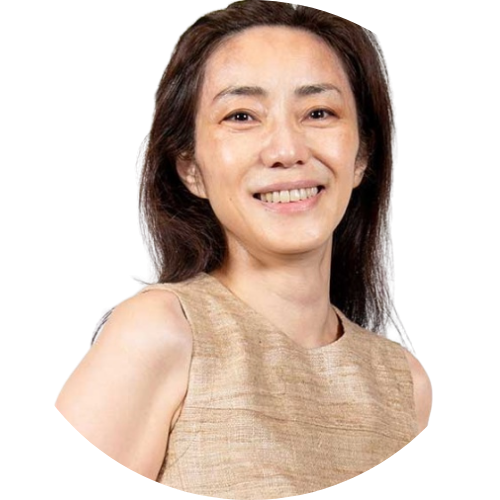
Professor Kae Nemoto
Okinawa Institute of Science and Technology and the Director of the OIST Center for Quantum Technologies
Short bio
Kae Nemoto is a professor at Okinawa Institute of Science and Technology and the Director of OIST Center for Quantum Technologies. She is also a professor at the National Institute of Informatics (NII) in Tokyo, where she serves as the director of the Global Research Center for Quantum Information. Her research is focused on quantum computer architectures, modeling and applications for quantum machine learning, quantum middleware, quantum devices, quantum networks, quantum internet and complex systems. She is leading several national research projects in the field of quantum information science and technology and is the founding leader of the educational platform "Quantum Academy for Science and Technology" to provide high quality lectures and education materials for undergraduate and graduate levels in this field. Her effort has also been devoted to implementation of quantum technology and its ecosystem in the industry. She is currently leading two industry-academia ecosystem platforms funded by the Japanese government as well as a founder of Quantum Forum.
She is a Fellow of both the IoP (UK) and the APS (US). She is decorated as Officer of the National Order of Merit of the French Republic in 2022 and has received the Science and Technology Award in the Research category from MEXT (Ministry of Education, Culture, Sports, Science and Technology) in 2025
Title of the talk
Quantum Machine Learning: An Alternative Route to Scalable Quantum Computer Technology
Short abstract
Scalability of quantum computer technology is essential for building a quantum computer capable of implementing various quantum algorithms. How scalable it needs to be, however, is not so clear. What we do know is that, if the technology is scalable enough to create a fault-tolerant quantum computer, that level of scalability is sufficient for now, as realising such a quantum computer remains a significant challenge.
To demonstrate scalability towards fault tolerance, quantum computer architectures are traditionally designed around quantum error-correction codes, which is a practical approach given the limitations of current hardware. However, such designs create a gap between physical quantum processors and fault-tolerant quantum computers. They also make it difficult to see how a quantum processor not yet large enough to be fault tolerant could be useful, and how to exploit the fast dynamics of physical quantum information processors.
In this talk, we briefly summarise this disjointed approach to scalability and discuss the possibility of application-oriented scalability for quantum information processors. We focus on quantum machine learning and discuss how we can diversify the design principles of quantum computer architectures to benefit from this freedom.