Solving Anion Transport Through Electrolyzer Membrane By Variational Quantum Algorithm

This abstract has open access
Problem description and relevance

We employ a variational quantum algorithm (VQA) to numerically simulate hydroxide-ion transport across a two-layer anion exchange membrane (AEM). An AEM electrolyzer, depicted in Fig. 1(a), uses the AEM to efficiently convert electrical energy into chemical energy stored in hydrogen, while safely separating hydrogen and oxygen production. Developing efficient hydrogen production methods like this is crucial for enabling sustainable energy systems and supporting the transition to a low-carbon economy.
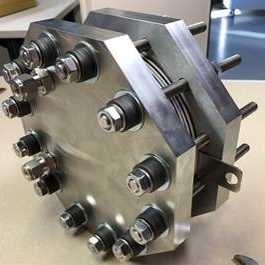
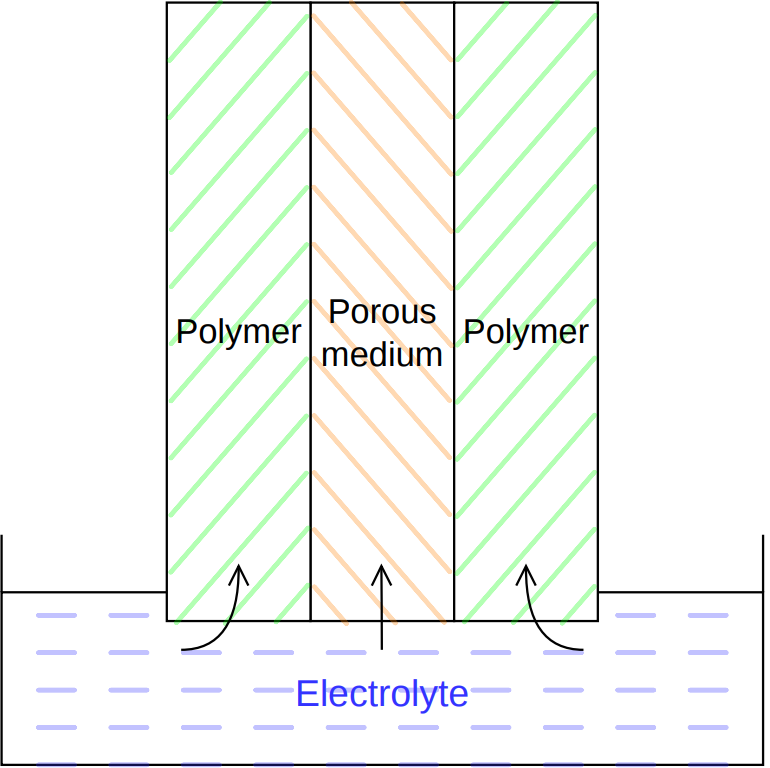
(a) An AEM electrolyzer (Fraunhofer IKTS Arnstadt)(b) Extended model with three layers

Figure 1: The AEM electrolyzer (left) and the extended model (right).


The mathematical model of the process is governed by a one-dimensional diffusion equation with a piecewise-constant diffusion coefficient and Dirichlet boundary conditions,

(1)


where c(x, t) is a time-dependent hydroxide-ion concentration, D(x) is a space-dependent piecewise-constant diffusion coefficient, and ΩT is a space-time domain.

In [1], we simulated the model (1) both classically and using the VQA, assuming simple spatial dependence, a piecewise constant diffusion coefficient D(x). The currently ongoing work investigates extensions of this model depicted in Fig. 1(b). In this extension, three layers are involved in the hydroxide-ion transport, whereas the water concentration cw(x, t) is also considered, such that the membrane's diffusivity D becomes a nonlinear function of the water concentration D = D(cw). Moreover, instead of Dirichlet boundary conditions, Neumann boundary conditions are imposed at the sides.

Submission ID :
22
Methodology :

The VQA methodology used in ref. [1] follows the work of ref. [2]. Using the Ritz-Galerkin method, the weak form of (1) is formulated as the following optimization problem,

(2)


where cl(x) is a concentration profile at the l-th time instant, and Δt is the time step. Applying the midpoint integration rule to (2) along with the central finite difference formula at staggered and collocated points results in a quadratic optimization problem. Solving the optimization problem produces a discrete solution of the weak formulation (2) of the PDE at the l-th time step. Quantum circuits based on the Hadamard test reported in [2, 3] are employed to evaluate the resulting quadratic and linear terms. Parameterized quantum circuits are used to encode the trial solution ĉlj and a special quantum state preparation routine is used to encode the coefficients of the terms quadratic in ĉlj.

A similar methodology will be used for the extended problem. The main challenge is to incorporate the dependence of D on the water concentration cw(x, t). One of the possibilities is to approximate D(cw(x, t)) as a polynomial of degree d,

(3)


and generalize the existing circuits to handle integer powers of cw(x, t) similar to the adder-potential-potential circuit [3]. In this case, we estimate the number of circuits to be linear in d. However, for moderate values, the same methodology as in [2] can still be applied.

Practical demonstration :

The circuits representing the terms of the cost function were implemented using the Qiskit quantum computing package. The parameterized real-amplitude circuit from the Qiskit circuit library with d = 4, 5, 6 layers was used for encoding ĉlj in all n = 4, 5, 6 qubit experiments, respectively. For preparing the coefficients of the cost function, a state preparation algorithm for piecewise-constant functions was developed. State vector simulations of these circuits, combined with optimization routines such as the Nelder-Mead, BFGS and covariance matrix adaptation evolution strategy (CMA-ES) [4] algorithms were performed to obtain a solution for the two-layer problem. Moreover, the time-independent steady-state and time-dependent analytical solutions of (1) were derived, allowing us to demonstrate the correctness of the VQA approach. Apart from the state vector simulations, shot-based simulations were conducted for D1 = 1, D2 = 0.5, and N = 16 (n = 4 qubits), see Fig. 2. While the BFGS algorithm demonstrated the best performance in state vector simulations, it failed to solve the problem when shot noise is present. On the contrary, CMA-ES was more robust to shot noise and was able to solve the problem with good agreement with the analytical solution. Our findings demonstrate again that the choice of the classical optimization routine is very problem-specific.

Figure 2: Comparison of various classical optimization algorithms subject to measurement noise for the case with D2 = 0.5 using N = 16 (4 qubits) internal grid points. Panels (a)–(c) show mean squared error (MSE) versus time step of the VQA relative to the analytical solution when 104, 105 and 106 shots are employed, respectively. Panels (d)–(f) show respective concentration profiles at t = 1.7 × 10⁻⁴ corresponding to 10 time steps. The legend holds for all panels.

Application potential :

The algorithm was applied to the two-layer problem without taking the dependence of D on cw(x, t) into account [1]. Current work will investigate the extended version of this problem in Fig. 1(b), with three layers and water content within the system to capture more physics of the hydroxide-ion transport in the membrane. As stated previously, approximating D(cw(x, t)) as a polynomial of degree d increases the number of circuits needed to evaluate the VQA cost function. However, d does not scale with the problem size, and we believe that D(cw(x, t)) can be approximated using a fixed low d.

Research Assistant
,
Technical University of Ilmenau
Institute of Physics, Technische Universität Ilmenau
University Professor
,
Institute of Thermodynamics and Fluid Mechanics, Technische Universität Ilmenau
11 visits