This work focuses on validating the linearization step and assessing its usefulness as quantum-compatible preprocessing, rather than on a full quantum implementation. We do not simulate a quantum circuit. Instead, we implement each classical linearization and compare its predictions against reference solutions of the original nonlinear systems obtained from higher-accuracy classical discrete time integration. In our earlier study, this comparison was carried out for Carleman and Liouville reformulations on nonlinear toy models [17]. In the present extension, we further investigate Liouville versus Fokker–Planck dynamics for the two-fixed-point toy model and for the Lorenz-63 system. The stochastic ensemble evolution is sampled by shot-based Monte Carlo simulations, while time evolution is computed via forward Euler time.
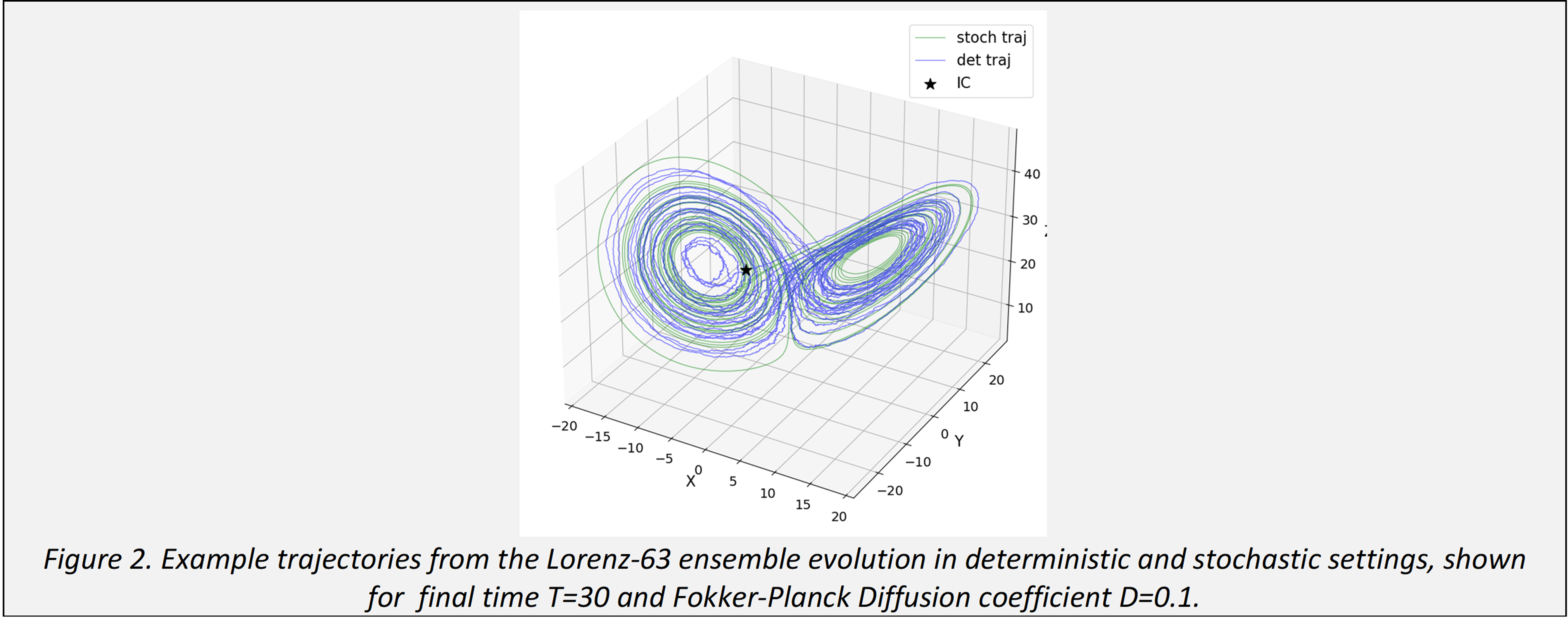
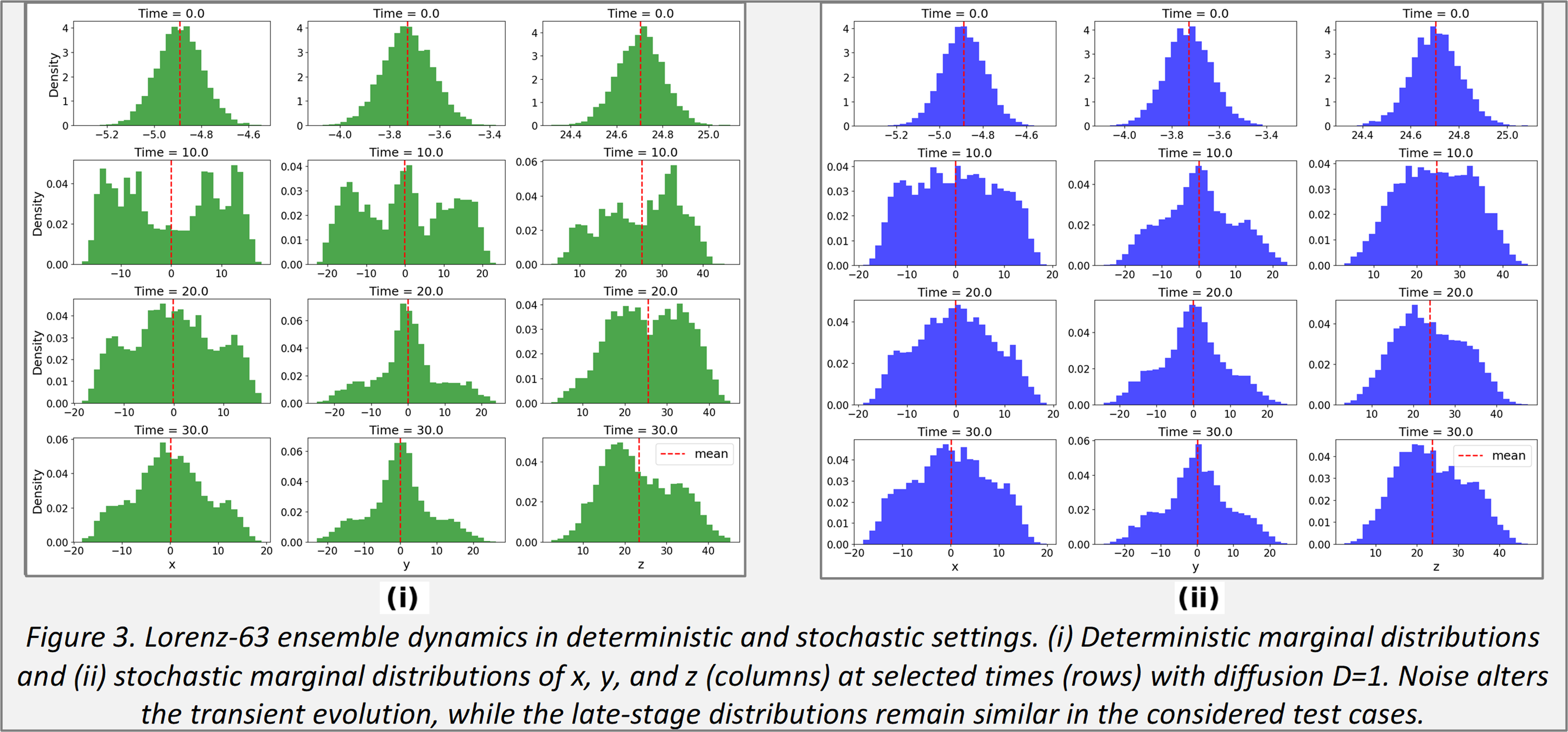
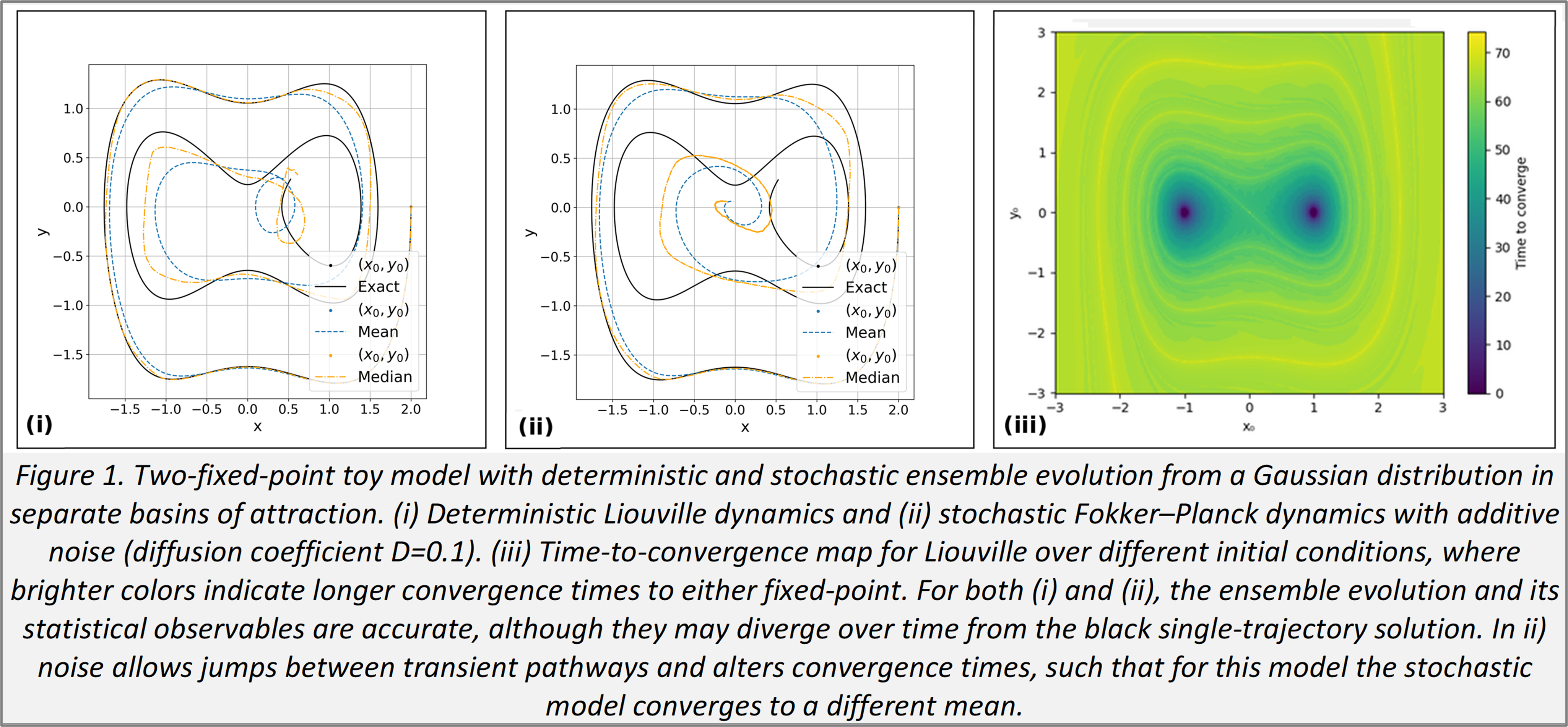 For the toy model, the deterministic Liouville formulation remains accurate in regimes where Carleman degrades because of truncation error. In this setting, its statistical observables agreed with the exact trajectory. Moreover, the ensemble evolution remains accurate over time up to finite-size effects. When additive noise is introduced (see Fig. 1), the transient ensemble evolution changes. Here, stochastic jumps allow ensemble members to switch between the deterministic phase-space paths, which can shorten convergence times (see Fig. 1 (iii)). Depending on the initial condition, this alters the intermediate dynamics of the ensemble evolution and can also change the long-term distribution. This effect seems to be relevant in systems with multiple basins of attraction and with absorbing fixed-points. For Lorenz-63, the effect of noise is different (see Fig. 2 and 3). The intermediate evolution is modified, whereas the long-time distribution remains similar in the tested cases. We interpret this difference as a consequence of the Lorenz attractor structure, where trajectories can repeatedly return between regions of phase space rather than becoming irreversibly trapped in fixed points. As both Fokker–Planck simulations accurately capture the ensemble evolution of their respective noisy systems, this highlights the importance of the noise model whenever transient dynamics, rather than only the steady state solution, are of interest.
In parallel, the linearized problems are assessed in terms of their general future quantum requirements based on [16-19], including the scaling behaviour, sparsity, conditioning, and qubit requirements.