Quantum Computing for Battery Materials Modeling

This abstract has open access
Problem description and relevance

Quantum computing (QC) holds tremendous potential for accelerating the simulation and design of energy materials, where classical computing methods are limited by the exponential divergence of complexity in high-dimensional materials configuration spaces. We develop and adopt tailored approaches for the integration of quantum-computing methods into modeling workflows for electrochemical materials [1,2]. Electrochemical reactions involve the transfer of both electrons and ions within the bulk, or at the surface, of active materials. Reliable theoretical predictions therefore require accurate descriptions of both the electronic and ionic structures of active phases, both of which pose tremendous challenges for classical simulation methods. A characteristic feature of active battery materials is the presence of occupational disorder within the ionic lattice. During charging and discharging, lithium ions, or other mobile ion species, are extracted, or inserted, into the lattice. The exponentially scaling number of possible arrangements of ions on the partially occupied sub-lattice makes the creation of representative atomistic models particularly challenging. Classically, this problem is addressed by the sampling of low- or lowest-energy configurations, e.g., by Monte Carlo methods or other classical optimization heuristics [3]. Quantum optimization techniques, such as adiabatic quantum annealing (QA), offer new avenues for tackling configurational combinatorics in battery materials modeling. QC has the potential to bypass these classical bottlenecks, in particular the use of quantum algorithms can allow for more efficient ground-state solutions of complex many-body electronic Hamiltonians with annealing-inspired methods, extending beyond simple approximations. Additionally, QC algorithms enable probing of larger materials spaces, which are needed for direct comparisons between simulation and experimental results.

Submission ID :
49
Methodology :

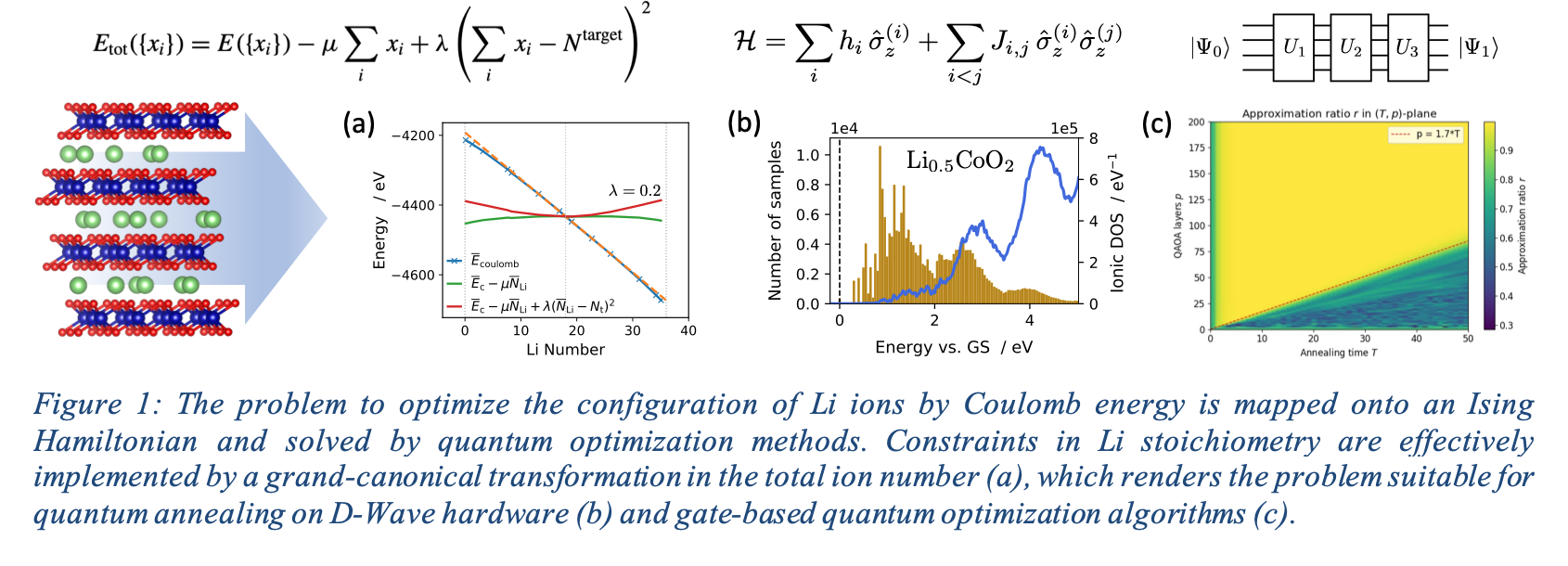
We have recently explored the use of a D-Wave quantum annealer to identify the ionic ground state of battery cathode materials, specifically lithium cobalt oxide (LCO) and lithium iron phosphate (LFP), by mapping the Coulomb energy of the system to an Ising Hamiltonian of binary site occupation variables (Figure 1). To simulate the materials at specified charging states, it is necessary to constrain the solution space to the targeted number of lithium ions. To this end, quadratic penalty terms are typically added to the energy cost function penalizing solutions that violate the constraints. For the cases studied, we found this approach to be impractical due to the large slope of the energy as a function of particle number, requiring very large quadratic bias that spoiled the success of QA. We solved this issue by introducing a Legendre transformation of the energy cost function in the Li-ion number. This grand-canonical transformation flattened the slope of the energy curve, which made it possible to implement the particle-number constraint with a weak quadratic bias and solve the ionic optimization problem on D-Wave quantum hardware. Similar constraints in particle numbers are ubiquitous in materials modeling, or, in the form of constraints for the Hamming weight, in general optimization problems. We thus expect our grand-canonical approach to be widely applicable.

Quantum annealing is limited to problems that can be represented by Ising-type Hamiltonians. To gain flexibility, our recent work explores the use of gate-based quantum algorithms, namely the quantum approximate optimization algorithm (QAOA), which can be motivated as a discretized form of quantum annealing. For sufficiently large number of layers, the QAOA process mimics an adiabatic state evolution and the output approaches the ground state solution (Figure 1c). Importantly, unlike QA, QAOA offers the possibility of a hard implementation of constraints by choosing mixing Hamiltonians that commutate with the constraint operator, e.g., an XY mixer for the particle-number constraint [4].

Practical demonstration :

The QA method for solving the ionic configurational problem was solved on the D-Wave quantum annealer JUPSI, installed at Forschungszentrum Jülich. The grand-canonical QUBO method developed enabled the successful identification of the ionic ground state. Figure 1b presents the spectrum of the D-Wave sampling output, together with the full density of states of the problem as determined by classical benchmark sampling methods. Interestingly, it was observed that the intrinsic sampling probability of the D-Wave annealer, obtained by normalizing to full output spectrum by the density of states, followed pseudo-thermal Boltzmann statistics, meaning that intrinsic probability for sampling the ground state was highest.

The QAOA method was tested using the Qiskit quantum simulator on classical hardware. Results shown in Figure 1c reveal a high approximation ratio of the ground state energy for sufficiently large number of layers and effective annealing time. A direct comparison between the X- and XY-mixer implementations for Li number constraints indicate similar performance of the two methods, however, at significantly larger quantum resource requirements of the XY-approach. This demonstrates better computational efficiency of QAOA with a standard X mixer and a soft constraint implementation following the grand-canonical QUBO approach developed for QA.

Application potential :

Our QA results show that existing quantum annealing hardware is already useful for solving challenging problems in battery materials research, provided an effective mapping of the problem and constraints is employed [1,2]. For the ground-state search, it took on average about 1000–10000 annealing runs to arrive at a successful solution (ground-state fidelities of about 0.01–0.1%). At an annealing time of about 100 microseconds per run, this corresponds to a total time to solution of the order of seconds-a considerable performance for combinatorial spaces with 30-40 logical variables explored. However, our analyses indicate that the pseudo-thermal output behavior will make it challenging to achieve a true exponential speedup in comparison to classical optimization heuristics.

The QAOA method developed for the ionic structure problem provides a promising starting point for interfacing ionic structure modelling by quantum optimization to electronic structure simulations with variational quantum algorithms, jointly addressing the ionic and electronic structure problems in battery materials simulations. We will provide an outlook of our extended activities working in this direction in the framework of QT-Batt, a major initiative within the Helmholtz Association of German Research Centres with the goal to accelerate the integration of quantum technologies in battery research. This recently launched project provides a unique ecosystem for the co-development of battery and quantum technologies with a special emphasis on the integration of methods along various dimensions, from atom-scale simulations to cell-level modelling, from quantum to classical computing techniques, and from modelling to experiment.

Associated Sessions

Postdoctoral Researcher
,
Forschungszentrum Jülich
Phd
,
Forschungszentrum Jülich
17 visits