Solving vehicle routing problems to optimality is particularly challenging, not only due to their NP-hardness, but also because naive model formulations often yield weak relaxations, an issue that leads standard solvers, like CPLEX or Gurobi, to perform particularly poorly. In turn, tight formulations of vehicle routing use variables that represent feasible routes. This causes the model to have a number of variables that grows exponentially with problem size, which makes even the relaxed (continuous) problem intractable.
Column generation is a method for solving Linear Programs (LPs) with a large number of variables, such as the relaxed tight formulation of vehicle routing. For this, a restricted version of the LP is solved, where only a subset of variables (routes) is considered, while the other are fixed to zero. An auxiliary problem, known as pricing problem, is solved to find new routes that must be added to the master problem in order to improve the objective function. In short, the master problem selects the best routes out of a restricted pool of possibilities, while the pricing problem introduces new routes into the pool. The algorithm alternates between solving each of the two problems, until no new improving routes are found by the pricing problem. Crucially, the effectiveness of the column generation algorithm relies on the ability to solve the pricing problem efficiently.
For the application of battery-constrained routing, the pricing problem is an NP-hard binary problem and can be cast into QUBO form. Particularly, the pricing problem takes the form
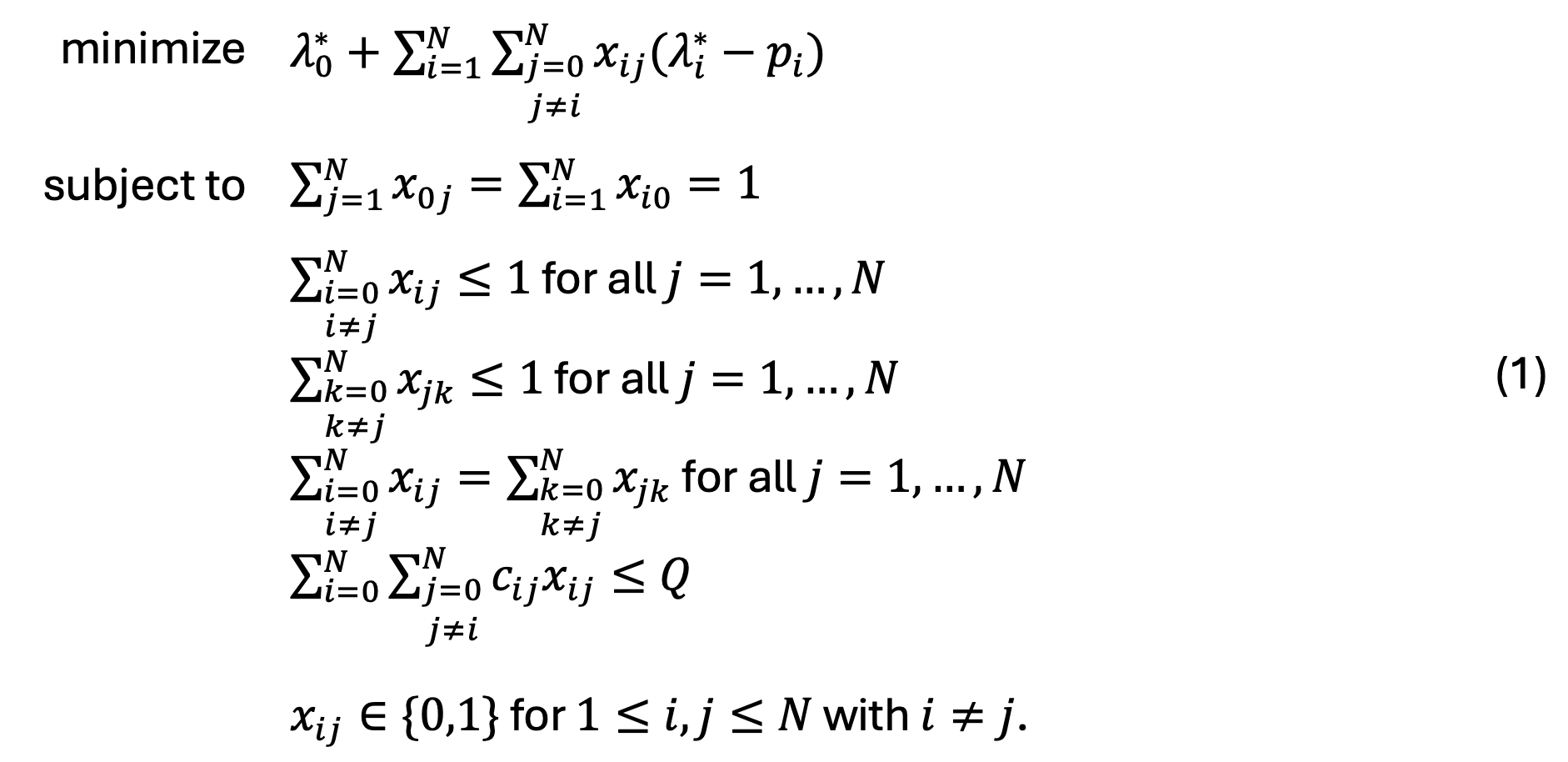
where the variables xij represent whether the route visits location j after location i, 0 is the index of the depot, Q is the battery capacity, N is the number of locations, pi is the prize for visiting location i, and { λk* }k=0N comes from the master problem.
The formulation above is known as the arc formulation. In (Kanai, 2024), a different model is used with variables qit representing whether location i is visited at time step t. This results in a quadratic objective function. Using the model of (Kanai, 2024) in our battery-constrained setting would further result in a quadratic constraint. This poses the following problem:
- Classical solvers deal better with linear objectives and constraints.
- In transforming such a model to QUBO form, the quadratic constraint cannot be efficiently translated into a penalty term.
For these reasons, we choose to use the arc formulation instead. This comes with a caveat: this formulation allows solutions with subtours, i.e., disconnected routes, as opposed to a single route. Subtours need to be eliminated by adding constraints that forbid them. Since the number of possible subtours is exponential, we add these constraints (or penalties in the case of QUBO) on-the-fly.