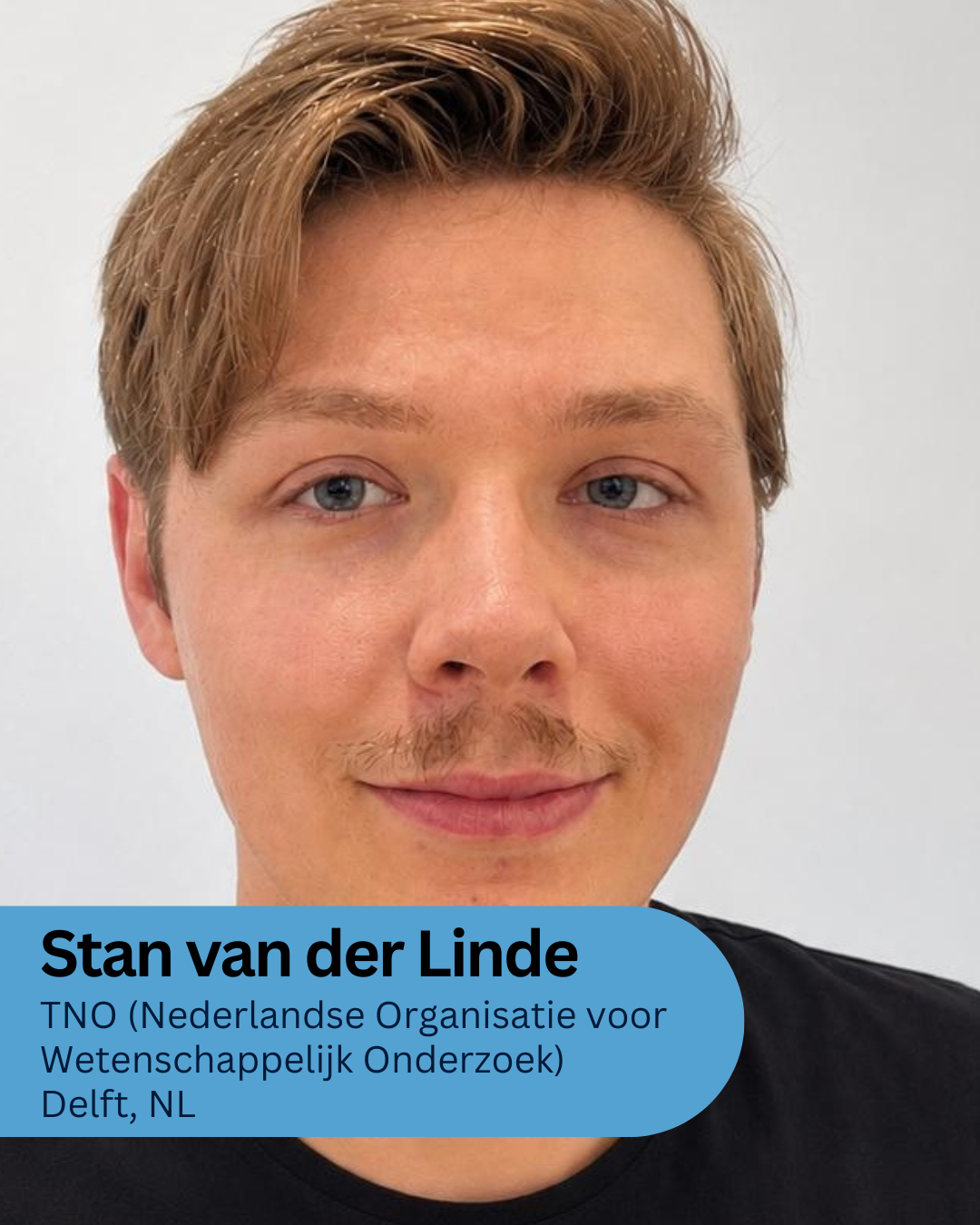




Stan van der Linde
TNO (The Netherlands Organisation for Applied Scientific Research), NL
Short bio
Stan van der Linde received his degree in Applied Mathematics from Delft University of Technology in 2021 . His background lies in computational science and engineering, with a focus on numerical mathematics, optimization, and quantum information.
Since 2022, he has been working at TNO (The Netherlands Organisation for Applied Scientific Research). His work focuses on developing and evaluating hybrid quantum-classical methods for large-scale optimization problems, with the goal of translating academic research into industrial applications. His research emphasized achieving practical performance gains on near-term quantum hardware.
Title of the talk
Hybrid Quantum Computing in Practice: Classical Lessons for Quantum Speedup
Short abstract
Hybrid quantum–classical algorithms are often presented as a natural path toward practical quantum advantage, yet their value ultimately depends on whether they can achieve meaningful speedups in practice. Achieving such speedups is far from straightforward, because different computational paradigms (annealing versus gate-based) give rise to different mental models, with important implications for the applicability and design of hybrid approaches.
This talk takes a broader perspective on hybrid quantum computing and how to think about performance, scalability and practical value in the near term. Concepts such as Amdahl's law offers intuitive guidance for understanding where speedups can realistically be expected, but also shows where the potential is severely limited. From this viewpoint, common pitfalls emerge, such as modeling and encoding choices that dominate computational cost and destroy potential speedups.
Furthermore, hardware-specific considerations play a central role in determining real world performance. Design choices including minor-embedding illustrate how low-level constraints can strongly influence algorithmic effectiveness.
Rather than presenting a single methodology, the goal is to outline a set of perspectives and design principles that help navigate the landscape of hybrid quantum computing and recognize where real-world value may, and where it is less likely to be found.